Digital pathology has transformed how slides are scanned, shared, interpreted, and increasingly analyzed by artificial intelligence. Yet one of the most repetitive parts of anatomic pathology still looks much as it did decades ago: small-biopsy grossing.
Every day, laboratory personnel open containers, verify identifiers, retrieve tiny tissue fragments, describe and measure them, transfer them into cassettes, document the process, and prepare the specimens for tissue processing. Each individual case may be straightforward, but the cumulative workload is substantial. The process is repetitive, dependent on careful manual handling, and vulnerable to tissue loss, identification errors, inconsistent descriptions, and workflow bottlenecks.
That is beginning to change.
A new generation of grossing technologies is bringing computer vision, structured imaging, artificial intelligence, robotics, digital traceability, and redesigned collection devices into the preanalytic phase. The emerging market is not converging on a single model. Instead, it is developing along several complementary paths, each addressing a different part of the problem.
Why small biopsies are the logical starting point
The gross room presents a difficult automation challenge because surgical specimens vary enormously in size, shape, texture, orientation, and clinical significance. Large resections require anatomical knowledge, judgment, dissection, margin assessment, and selective sampling. These tasks are unlikely to become fully automated in the immediate future.
Small biopsies are different.
Many are submitted entirely, require relatively standardized descriptions, and undergo a predictable sequence of identification, imaging, measurement, transfer, cassette preparation, and documentation. Examples include gastrointestinal biopsies, skin specimens, cervical biopsies, prostate cores, and other small tissue fragments.
This does not make them unimportant. On the contrary, their small size increases the consequences of losing, fragmenting, or misidentifying tissue. But their relatively consistent workflow makes them an attractive entry point for automation.
A recent review of pathology automation concluded that automation can improve efficiency, reliability, and traceability across the histology workflow, while also acknowledging cost, infrastructure, and incomplete coverage of specialized tasks as continuing barriers.
Three emerging models of grossing automation
The current landscape can be understood as three overlapping approaches: workflow augmentation, robotic grossing, and collection-to-cassette redesign.
1. AI-assisted workflow augmentation
The first approach preserves the conventional grossing process while automating selected cognitive and documentation tasks.
Vistapath’s Sentinel, for example, uses computer vision to photograph and measure specimens, scan containers and cassettes, structure the information collected at the grossing bench, and create gross reports. The company says the platform can photograph and measure a specimen in under one second and reduce end-to-end grossing time by more than 90 percent. These are company-reported performance claims that will require evaluation within each laboratory’s actual workflow.
The appeal of augmentation is its relatively low disruption. Laboratories can retain their existing specimen containers, personnel, and physical workflow while adding digital documentation, measurements, identity checks, and quality-assurance data.
This approach is also demonstrating commercial traction. PathGroup announced plans to expand Sentinel from its Nashville operation to two dermatopathology centers, adding 15 units beginning in January 2027. The company cited standardized specimen handling across shifts and support for turnaround-time goals following its initial deployment.
The limitation is that augmentation does not necessarily remove the physical handling steps. A person may still need to open the container, retrieve the tissue, manipulate or orient it, place it into the correct cassette, and manage exceptions. The workflow becomes better documented and potentially faster, but it remains substantially human-operated.
2. End-to-end robotic grossing
The second approach seeks to automate both the information workflow and the physical movement of tissue.
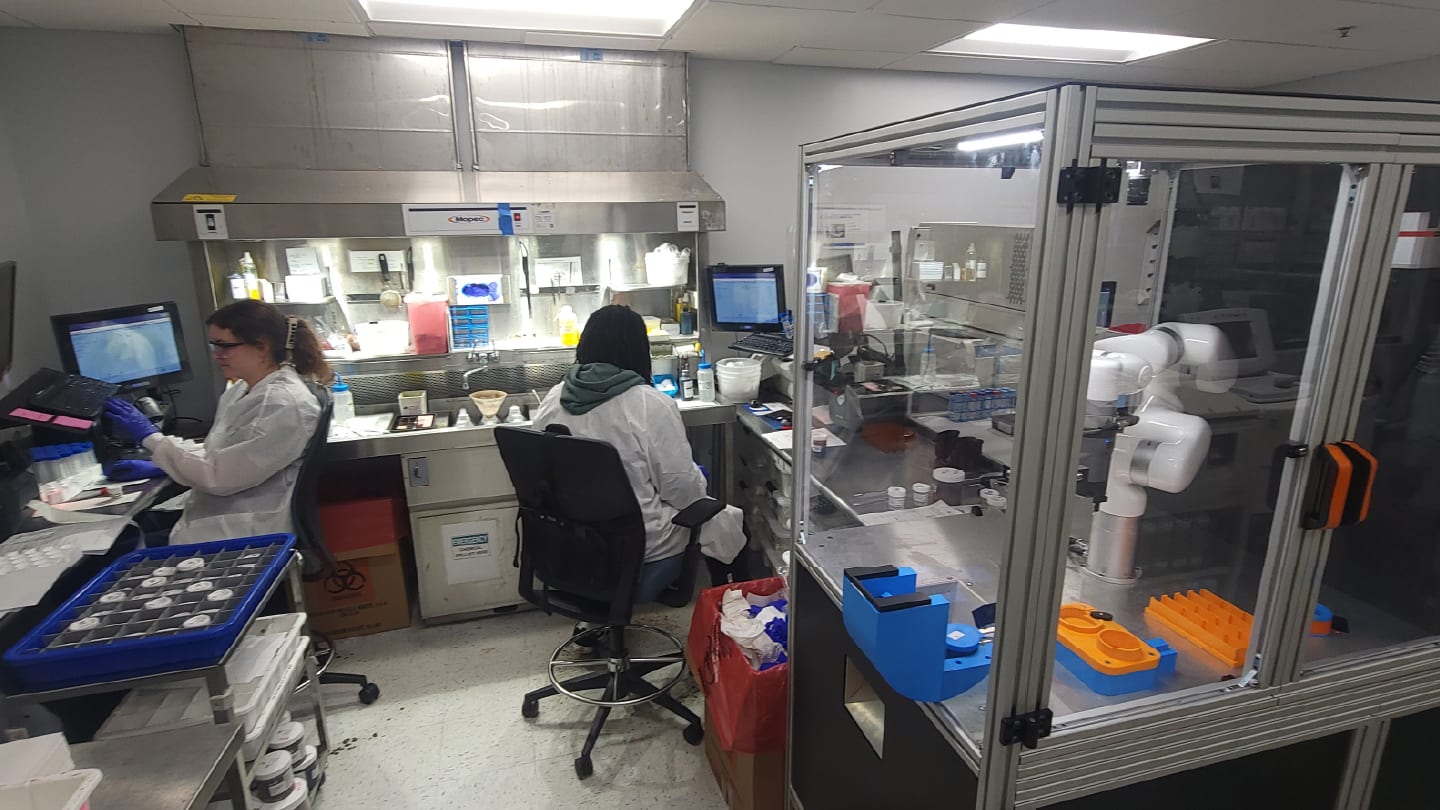
FormaPath’s nToto platform is designed to accept multiple specimen containers, match EMR and LIS labels, use computer vision to count and measure tissue, generate gross-description data, print barcoded cassettes, and robotically transfer specimens. The company states that the system can hold as many as 60 specimen jars and is intended for specimens that can be submitted entirely in a single cassette, particularly upper and lower gastrointestinal biopsies. It does not currently dissect or orient tissue.
The system represents a traditional laboratory-automation model: specimens enter in standard containers, and robotics reproduce many of the steps that a human operator previously performed. Its strengths include compatibility with familiar collection practices, high-volume batch processing, reduced operator involvement, and the creation of a digital audit trail.
FormaPath initially developed the system in collaboration with Mayo Clinic’s Advanced Diagnostics Laboratory. Early work examined variability in conventional tissue-biopsy grossing and compared human performance with an automated vision system.
This approach may be particularly attractive to high-volume laboratories with relatively standardized specimen streams. Its central technical challenge is reliable tissue retrieval. Small, translucent, fragmented, floating, or adherent specimens can be difficult for both humans and machines to detect and transfer consistently.
3. Collection-to-cassette workflow redesign
A third model questions whether specimen transfer should occur at all.
NCRatio’s Rokitansky Grossing System is being developed around a zero-transfer workflow. Its companion Ranvier Collection Device integrates the specimen container and tissue cassette so that the specimen is collected directly into the cassette rather than being transferred from a conventional jar later in the laboratory.
The proposed workflow combines identity verification, in-situ imaging, machine-vision confirmation, cassette marking, AI-generated gross descriptions, and human review. NCRatio’s public materials position the integrated collection device as a way to reduce tissue loss, fragmentation, cassette-placement errors, and fixation problems associated with manual transfer.
The company demonstrated a second-generation prototype in July 2026 and has begun an early non-clinical pilot at Allīne Laboratory in Tampa, Florida. The system remains investigational, has not been cleared by the FDA, and has not yet produced published performance data.
This model shifts automation upstream. Instead of building a robot that reproduces every manual transfer step, it attempts to remove one of the most failure-prone steps through product and workflow design.
The tradeoff is adoption complexity. A specialized collection device may require changes at the point of care, staff education, defined eligible specimen types, supply-chain coordination, and careful integration with accessioning and transport procedures. The value proposition will therefore depend not only on what happens inside the gross room but also on whether the collection workflow can be implemented reliably across clinics, procedure areas, and laboratory sites.
Robotics and AI are beginning to converge
The distinction between augmentation and full automation may not remain fixed.
In October 2026, Vistapath and Tactus AI announced plans to connect Sentinel’s imaging and specimen-level data with Elsie, Tactus AI’s autonomous laboratory assistant. Initial development is expected to focus on specimen and cassette handling and movement between the grossing station and downstream processing. The companies have emphasized that these combined workflows remain under development and are not yet ready for clinical use.
This collaboration illustrates the likely direction of the field. Imaging systems can provide perception. Laboratory information systems provide identity and workflow context. Robotics provide physical action. AI can help coordinate the three.
The eventual goal may not be a single machine that performs every task. It may be an interoperable environment in which collection devices, imaging platforms, robotic handlers, cassette printers, processors, and laboratory information systems share a continuous specimen record.
The real competition is not simply speed
Early automation discussions often focus on throughput and labor savings. Those benefits matter, but speed alone will not determine adoption.
For laboratories, the more consequential questions will include:
Was the correct tissue placed into the correct cassette?
Can the system detect an empty container or incomplete transfer?
What happens when tissue is folded, fragmented, adherent, fatty, or difficult to visualize?
Can every image, measurement, exception, and human intervention be reconstructed later?
Does the technology integrate with the LIS without creating another isolated data system?
Can personnel override the technology when the specimen does not fit the expected workflow?
Does the system improve tissue recovery, fixation, consistency, or diagnostic quality?
Does it reduce total labor, or merely move work to another part of the process?
What are the capital, consumable, service, validation, and training costs?
Which specimen types should remain outside the automated pathway?
Dennis Strenk, a pathologists’ assistant and advocate for gross-room modernization, has described the evolving digital gross room through three concepts: intake, integration, and intelligence. His framework emphasizes that images, measurements, annotations, and sampling data should remain connected to the specimen throughout the diagnostic process. He also argues that technology should support, not replace, professional judgment.
That distinction is important. The strongest case for automation is not that human expertise is unnecessary. It is that scarce expertise should be concentrated where it creates the most value.
Evidence will separate compelling demonstrations from durable products
The automated-grossing field has moved beyond theoretical feasibility. Systems are being demonstrated at national meetings, deployed in laboratories, expanded across multiple sites, and connected with broader robotic platforms.
The next phase must be evidence-driven.
Useful validation should extend beyond whether a machine can complete a demonstration. Laboratories will need data on tissue recovery, failure rates, misidentification risk, gross-description accuracy, fixation quality, throughput under routine operating conditions, downtime, exception frequency, staff intervention, and downstream slide quality.
Economic evaluations should examine the entire workflow. A system that saves several minutes at the grossing bench may still create costs in accessioning, collection, maintenance, consumables, or exception handling. Conversely, a platform that appears more expensive initially may provide value by preventing lost tissue, standardizing operations across shifts, enabling remote review, or allowing skilled personnel to focus on complex specimens.
Independent, peer-reviewed studies and transparent multi-site pilot results will be especially important. Most publicly available performance information currently comes from manufacturers or their laboratory partners.
A connected gross room, not an empty one
Automated small-biopsy grossing is unlikely to produce a gross room without people. A more realistic future is a gross room in which repetitive physical and documentation tasks are increasingly managed by machines, while personnel supervise exceptions, validate results, and concentrate on specimens requiring judgment.
Different laboratories may choose different entry points. Some will begin with AI-assisted imaging and reporting. Others may adopt robotic transfer for high-volume specimen categories. Still, others may redesign collection so that tissue arrives already secured within the processing cassette.
These models are not necessarily mutually exclusive. Over time, they may converge into a connected preanalytic ecosystem extending from the procedure room to the cassette, tissue processor, slide, and final pathology report.
The significance of this transition reaches beyond efficiency. Grossing is the first major opportunity to establish specimen identity, document tissue condition, capture structured information, and protect the integrity of the material on which the diagnosis depends.
The gross room has long been one of pathology’s least digitized spaces. Small-biopsy automation may be the practical opening through which that finally begins to change.
Newsletters
Receive the latest pathologist news, personalities, education, and career development – weekly to your inbox.