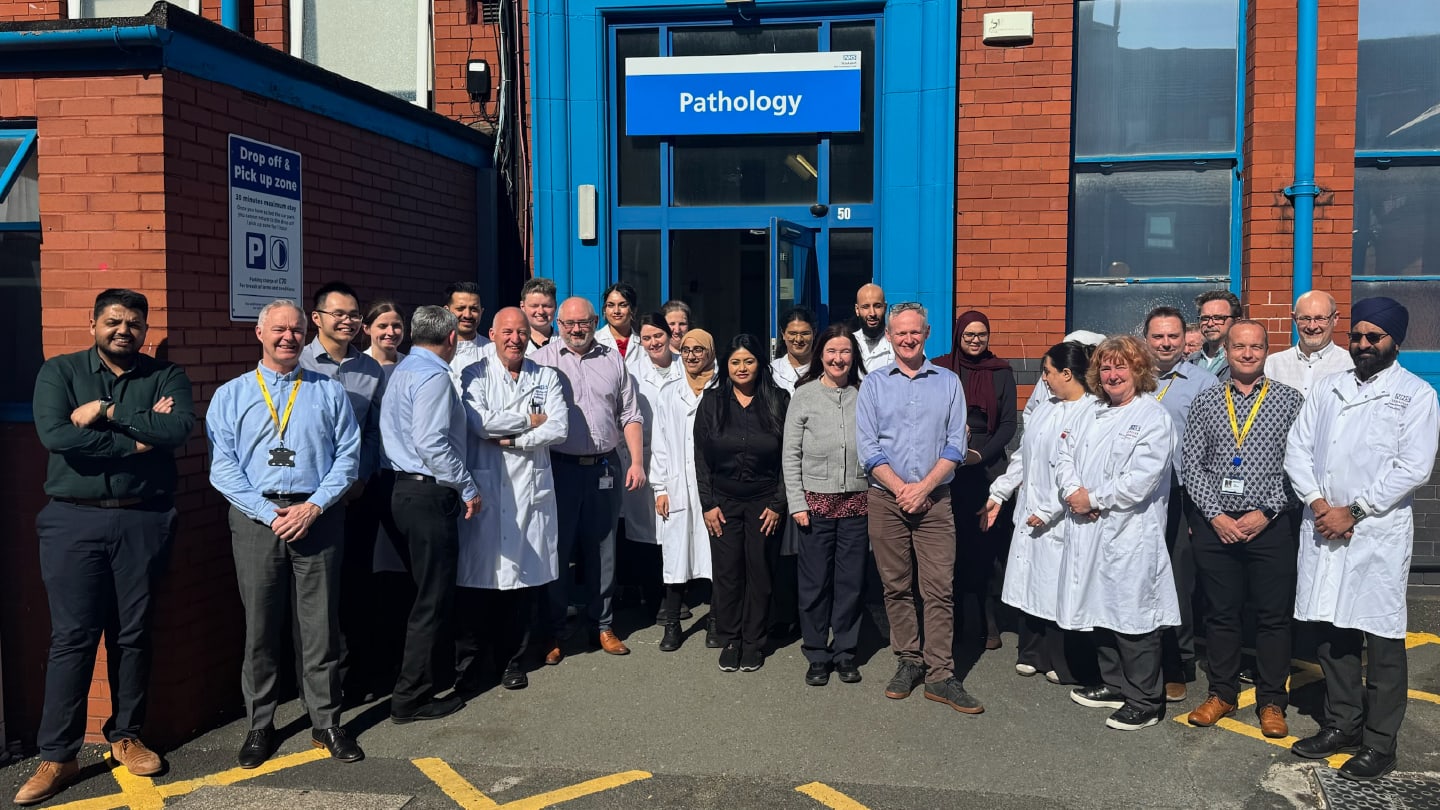
Walking into the pathology department at the Stockport National Health Service (NHS) Foundation Trust feels a little like stepping back in time. In an unassuming corner of the northwest of England, this single story, red brick building dates back to the early 1900s. In the cramped corridors and poky rooms, "storage" amounts to piles of boxes stacked among the analyzers and equipment.
"We ran out of room a long time ago," admits Associate Divisional Director for Pathology Mark Gordon. "And the building layout actually opposes the smooth flow of work from sample reception to analysis," he adds.
Yet, while the building may show its age, the diagnostics inside are anything but dated. As Gordon shows me around the various sections in the department, I see blood samples whizzing round an automated track, in-house PCR in microbiology, a high-tech blood bank, and digital slide scanners being loaded for action.
What’s more, all this technology works seamlessly together, with every sample meticulously tracked and every report delivered promptly to the ordering physician. Behind it all is the brand-new laboratory information management system (LIMS) that Gordon and his team have spent the past three years planning and implementing.
As we retreat into Gordon's windowless office in the belly of the building, he shares the story of the transformative technology upgrade.
Legacy technology at its limits
Despite its physical constraints, this is a busy pathology service. The department performs around 10 million tests each year for a population of approximately 270,000 people in Stockport, as well as patients in the neighboring High Peak area.
By far the greatest volume passes through blood sciences, which handles around 8.7–8.8 million tests annually. Microbiology performs approximately 600,000 tests across 125,000 patient encounters, while cellular pathology produces some 144,000 slides from 21,500 cases.
At the heart of all this activity, until recently, was a LIMS that had been in place since 1992. Replacing Telepath after more than three decades was, Gordon says, a "once-in-a-generation change."
Its longevity was testament to the technology. "It's notably impressive that it still works when the software was written in the late 1980s," he says. But a system designed for another era was inevitably becoming harder to reconcile with the demands of a modern pathology service.
For one thing, Telepath relied on physical servers, limiting the resilience that can now be achieved through virtualization. Connecting it to newer technologies was also becoming increasingly cumbersome. "We were using all sorts of add-on printer drivers just to get paper reports out of it," Gordon recalls. And extracting the information needed for increasingly sophisticated reporting requirements was becoming difficult.
Those limitations were starting to have practical consequences. New transfusion reporting requirements due to take effect in 2026 demanded information that the existing system could not readily provide. Changes to cancer registry reporting posed another problem, with XML files replacing the CSV format supported by the old LIMS.
Protecting the brain-to-brain loop
Moving to WinPath therefore wasn't simply about replacing an aging piece of software. The new system could be virtualized for greater resilience, communicate with other systems using modern HL7 standards, and provide much more flexible reporting. It also brought a rather more visible change for the people using it every day.
"The old system was green text on a black screen," says Gordon. WinPath's Windows-based interface is much closer to the software people encounter elsewhere in their working lives. For new recruits in particular, he adds, that means they are "less shocked by the computer system that they are being asked to use."
With millions of results passing through the laboratory every year, however, replacing the system that controls them was never going to be as simple as switching off one LIMS and turning on another. The overriding priority was ensuring that nothing was lost or altered along the way.
Gordon describes this as protecting the "brain-to-brain loop" – the entire journey from a clinician requesting a test, through analysis in the laboratory, to the correct result appearing in front of the person who ordered it. At Stockport, that journey extends across numerous hospital systems and around 40 GP practices, ultimately feeding results into some 700 different inboxes.
The potential consequences of even a tiny error made rigorous testing essential. "If you had an HIV result and, for whatever reason, the end of a line was getting curtailed, and the bit that was lost happened to be 'not' and the next word was 'detected,' you're giving a very different result," Gordon explains. "You need to be 100 percent certain that what you're sending out is getting to the destination and appearing correctly."
That risk shaped the project from the outset. Before going out to tender, the team mapped exactly what the new LIMS needed to do: connect reliably with the laboratory's analyzers and external systems, accommodate the necessary capacity, and, above all, ensure that every request and result reached the right destination intact.
A cautious approach to implementation
That same focus on risk shaped the decision to implement the new LIMS in two phases. Rather than attempting a single, trust-wide switchover, Stockport began with microbiology and cellular pathology in September 2025, before bringing the much higher-volume blood sciences and transfusion services across the following April.
Starting with the lower-throughput disciplines gave the team an opportunity to see how the new system performed under real-world conditions. "You can do as much testing as you like – we could have kept testing forever," says Gordon. "When you actually go live, there will still, inevitably, be some snags."
With smaller volumes, any unexpected problems could be investigated and managed without overwhelming the service. Just as importantly, any fixes could be thoroughly tested before they were introduced, reducing the risk of solving one problem only to create another.
That margin for error would disappear once blood sciences came online. "If you're getting 30,000-plus results a day out on any given assay, it's not going to be something that's possible to recover from without affecting your patient cohort and your users," Gordon says.
By putting the LIMS through its paces in two different departments first, the team gained something difficult to replicate in a test environment: confidence that the system could cope when the stakes – and the volumes – became much higher.
Embracing the new system
Technology was only part of the transition. For Gordon, an equally important challenge was bringing the people who use the LIMS every day along with it.
"Change is always something you need to take people through," he says. "We have some members of staff who've been here since 1986." For those who knew Telepath "like the back of their hand," moving to an entirely different system meant relinquishing decades of familiarity – a particular concern for staff running the laboratory alone overnight.
The department therefore relied heavily on peer-to-peer training. A core group developed expert knowledge of the system, with support from the vendor, before sharing that knowledge with colleagues. Training was tailored to different roles, recognizing that a consultant biochemist, for example, interacts with the LIMS very differently from a medical laboratory assistant.
Even with that preparation, there has inevitably been a period of adjustment. Familiar codes have changed, some tasks initially take longer, and extra staff have been needed in blood sciences reception while people get up to speed. But, for Gordon, that learning curve is part and parcel of asking a workforce accustomed to one system for more than 30 years to embrace another.
Collaborating with community care
The team took a similarly collaborative approach with primary care. With results flowing out to GP practices across the area, Gordon knew that the transition could not be managed within the walls of the laboratory alone.
"We had very open, honest conversations with them from the beginning," he says. The pathology team attended GP quality and governance meetings, provided regular updates, and established a small working group with the Integrated Care Board that included a GP and practice manager.
Their involvement proved invaluable. As well as helping to test that results were reaching the right destinations, primary care colleagues could quickly flag when a change was having an unintended effect. Crucially, those relationships were already in place when the system went live.
Practical payoffs
Several months on, Gordon acknowledges that the transition remains a work in progress. There have been "a few grumbles" from staff accustomed to Telepath and some processes are still being refined. But the benefits of moving to a modern system are becoming increasingly apparent.
For Gordon, one of the biggest gains is access to data. Every morning at 5 am, the new LIMS automatically generates a snapshot of histopathology activity and throughput and sends it to his inbox. "Rather than having to come in and manually gather that, the data's there for me to look at straight away," he says.
There are less visible benefits too. Moving away from an aging platform means the department is no longer dependent on an increasingly small pool of people with specialist knowledge of technology developed decades ago. For Gordon, that makes the upgrade as much about putting pathology on a sustainable footing for the future as improving how it operates today.
The digital future
A week after meeting Gordon, he contacts me with exciting news. Stockport NHS Foundation Trust has confirmed funding for a new, purpose-built pathology building. The department can now look forward to a modern infrastructure capable of accommodating future diagnostic technologies, with its digital foundations firmly embedded.
Yet, even surrounded as it is now, by walls from another era, Stockport pathology has its sights firmly on the future. As part of the Greater Manchester Digital Pathology Network, the Stockport NHS Foundation Trust is exploring how closer connectivity between trusts could allow samples, expertise, and even staff to move more easily across traditional organizational boundaries.
With financial pressures mounting and workloads continuing to grow, Gordon sees greater collaboration as essential. "We need to find ways to be more efficient and work more efficiently together," he says. And with many trusts across Greater Manchester now using modern LIMS, the infrastructure is increasingly in place to make that possible – helping pathology services operate, in Gordon's words, "as a real core network together rather than isolated silos."
Learning from the Stockport story
For pathology leaders contemplating a similar move away from a deeply embedded legacy system, Gordon offers a few lessons from Stockport's experience:
Resource the project properly. "You will end up spending the money one way or another," he says. Backfill key laboratory staff so they have sufficient time to help build, test, and validate the new system without compromising the day-to-day service.
Be realistic about timelines. Supplier timelines may not account for competing pressures within the laboratory. Build in enough time for unexpected demands while keeping business as usual running safely.
Test, test, and test again. Use digital tools where possible to manage validation, track progress, document evidence, and maintain oversight. "The more testing you can do, the better."
Bring users into the process. Engage hospital clinicians and GPs early, show them what is changing, and seek their feedback on how results and reports will appear. As Gordon's experience shows, strong relationships can make the eventual transition considerably smoother.
Newsletters
Receive the latest pathologist news, personalities, education, and career development – weekly to your inbox.