A system under strain
Pathology stands at the center of modern medicine. As the discipline that translates scientific innovation into clinical action, it enables earlier detection, more precise diagnoses, and more personalized treatment decisions. Yet as precision medicine accelerates, many laboratories are confronting a hard operational truth: scientific progress is outpacing the workflows required to deliver it at scale.
That disconnect is especially visible in immunohistochemistry (IHC), where growing test complexity, higher case volumes, and persistent staffing shortages are converging into one of pathology’s most consequential bottlenecks. If laboratories cannot consistently move IHC work through the system with speed, discipline, and quality, the promise of precision medicine risks being slowed not by science, but by operations.
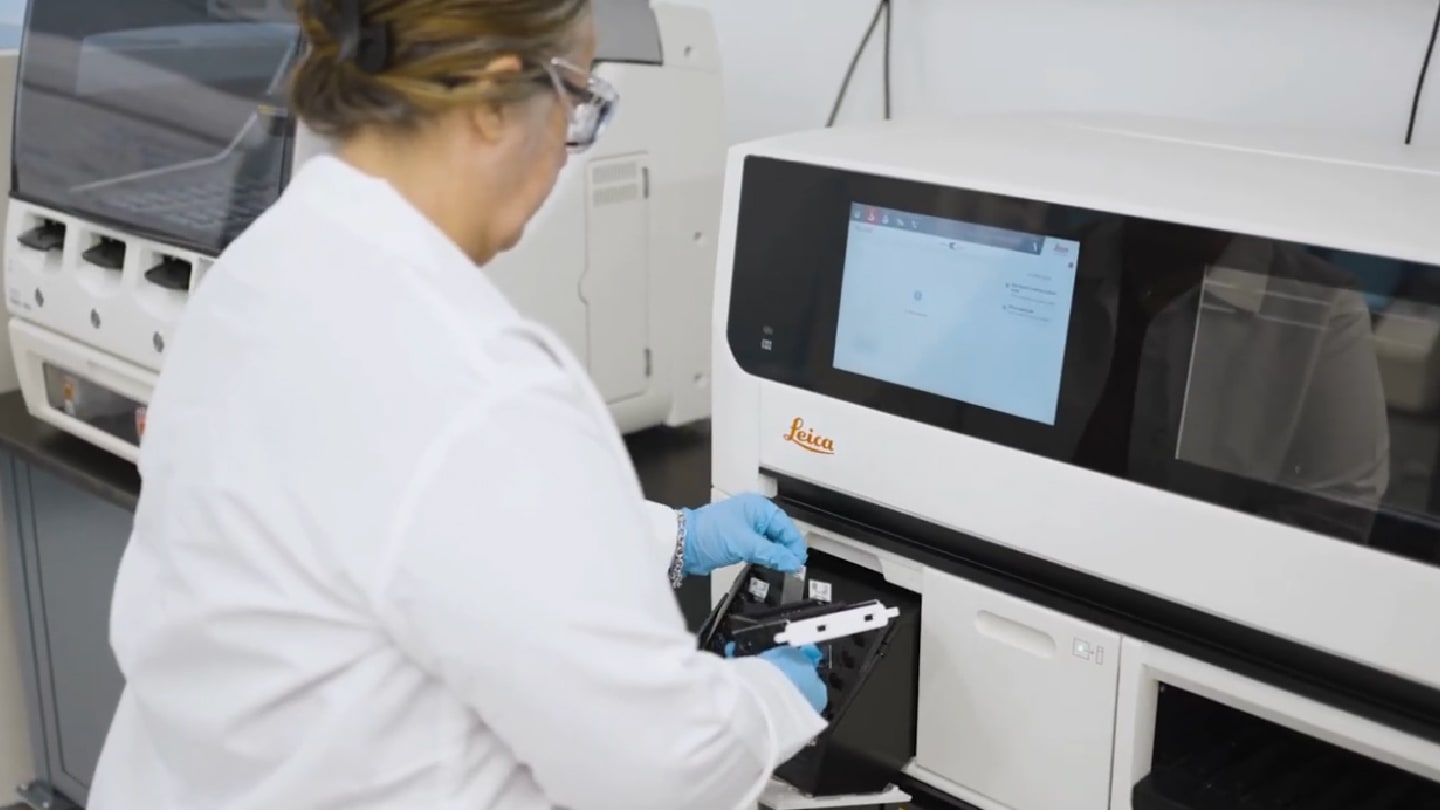
The perfect pathology storm
Pathology laboratories are already navigating a structural imbalance, which will only intensify as demand continues to rise. The World Health Organization anticipates more than 35 million new cancer cases by the year 2050, adding significant volume to laboratory systems that are already under strain (1). Rising cancer incidence, expanding biomarker menus, and broader adoption of IHC is increasing slide volumes and testing complexity, while staffing capacity has not kept pace. Every new indication, additional marker, and shift toward more individualized care adds operational weight to an already strained system.
At the same time, the workforce challenge remains acute. Industry reports continue to show persistent vacancy rates in anatomic pathology and histology, along with long hiring timelines that make it difficult for laboratories to stabilize operations (2).
The IHC bottleneck effect
David Newell is a workflow solutions consultant at Leica Biosystems, a Danaher company, helping laboratories of various sizes and disciplines to streamline their workflows and maximize efficiency. With more than 25 years in the field and more than 70 laboratory workflow assessments, he also uniquely understands the challenges facing today’s labs.
“Operationally, the bottleneck concentrates in IHC – specifically across three failure points: order intake, instrument loading, and unloading,” Newell explains. “Paper- or batch-based order workflows delay start times, while batching behaviors and inconsistent instrument interaction create avoidable idle time. The persistence comes from the intersection of people constraints and process design gaps. Even skilled staff are constrained by fragmented ordering systems, artificial batching, and limited operating windows.”
This is why IHC matters so much operationally. It is not simply another step in the workflow; it is a decisive throughput node that influences everything downstream. When IHC slows, the impact is rarely contained to a single bench or instrument. It affects handoffs, quality control, pathologist review, and ultimately the timeliness of answers delivered to clinicians and patients.
“When IHC processes are batch-triggered or delayed at intake, rework compounds delays because repeats must re-enter the same constrained system, often at the back of the queue,” says Newell. “IHC rework is not isolated; it creates a cascade effect, extending turnaround time through re-embedding or recutting, re-staining queues, and pathologist re-review cycles. For high-complexity cases, this can shift reporting timelines significantly, particularly in labs already operating at capacity.”
In high-volume environments, these disruptions do not remain isolated. They compound. A delayed start, a repeated stain, or an idle instrument can trigger a chain reaction across the laboratory, extending turnaround times and increasing pressure on already constrained teams.
Beyond short-term solutions
The instinct in many organizations is to respond by adding more staff, more instrumentation, or more shifts. But resources alone rarely solve a workflow problem. Without a clear, data-driven understanding of how work enters, moves through, and exits the system, incremental investments can leave the underlying causes of delay untouched.
Without a data-driven understanding of the workflow, adding resources rarely addresses root causes.
“Even with sufficient instrumentation, labs often underutilize capacity due to restricted operating windows and batching habits,” Newell explains. “For example, we found that expanding IHC staining-area coverage from 8 to 9.5 hours daily, combined with workflow changes, increased daily staining capacity from 120 to 180 slides by enabling three runs per day, all without new equipment (3). The missing element is workflow orchestration. Throughput is constrained less by capacity and more by when work enters the system, how continuously instruments are fed, and how quickly runs are turned.”
A robust quality management system needs to be actively monitored and discussed. It is essential for sustaining both speed and accuracy.
“Process delays often create rushed downstream steps; smoother upstream flow reduces error pressure without sacrificing quality,” Newell adds. “Quality and speed are not competing priorities. In optimized IHC workflows reduced variability means fewer repeats. Along with that, standardization creates more predictable outcomes.”
From bottleneck to strategic advantage
The laboratories best positioned for the future will be those that stop treating workflow as a background operational issue and start managing it as a strategic capability. Operational resilience is no longer about asking teams to work harder within outdated processes; it is about designing systems that can absorb complexity, support consistency, and scale with the evolving demands of modern diagnostics.
A comprehensive, end-to-end review of the workflow is often the most effective starting point for identifying bottlenecks and uncovering opportunities for improvement. By bringing together stakeholders across departments spanning the lab, operations, IT, and clinical teams, organizations can create space for open, candid dialog around what is and isn’t working today.
These cross-functional conversations are critical in identifying not only visible inefficiencies, but also the less obvious friction points that accumulate across handoffs, processes, and systems. From there, teams can align on a clear vision for the future state, one that reflects both current needs and anticipated growth. Meaningful workflow transformation depends on disciplined change management and realistic timelines; success requires alignment across stakeholders and cannot be achieved through rushed, siloed efforts.
This evaluation also enables organizations to proactively assess expansion requirements, such as increasing test volumes, adoption of digital workflows, or integration of new technologies like AI. Just as importantly, it helps define the infrastructure needed to support that evolution successfully.
Ultimately, a top-to-bottom workflow strategy enables laboratories to move beyond isolated fixes and toward coordinated, durable improvement. That matters not only for efficiency today, but for readiness tomorrow, as digital pathology, AI-enabled tools, and increasingly complex biomarker testing become more deeply embedded in routine care. Recent reviews across the field point to accelerating adoption of digital pathology and AI, but also emphasize that real clinical value depends on thoughtful workflow integration, validation, and operational readiness. Technology alone is not enough; it must be implemented within workflows that are built to support scale and consistency (4).
“Labs must design workflows that maximize existing staff productivity, including extended coverage models and better spatial organization of workstations,” Newell advises. “Future-ready laboratories will design workflows around skill optimization, not simply headcount, while aligning histology operations with downstream molecular and digital pathology demands. The goal is to build a system that can absorb volume growth and rising complexity without requiring proportional increases in staffing.”
The science of pathology has never been more advanced, and the expectations placed on laboratories have never been higher. The next frontier is not simply discovering new biomarkers or adopting new technologies. It is building laboratory operations capable of delivering that innovation with consistency, speed, and confidence. Solving the IHC workflow challenge is not just an operational necessity; it is a leadership imperative for the future of pathology, research, and care.
Newsletters
Receive the latest pathologist news, personalities, education, and career development – weekly to your inbox.

References
- 1. World Health Organization, “Global cancer burden growing, amidst mounting need for services,” news release, February 1, 2024. Available at: https://www.who.int/news/item/01-02-2024-global-cancer-burden-growing--amidst-mounting-need-for-services.
- 2. E Garcia and J Diaz, “ASCP 2024 vacancy survey report highlights policy priorities to address laboratory workforce shortages through credentialing, advocacy, and education expansion,” Critical Values (2026). Available at: https://criticalvalues.org/news/all/2026/01/27/ascp-2024-vacancy-survey-report-highlights-policy-priorities-to-address-laboratory-workforce-shortages-through-credentialing--advocacy--and-education-expansion.
- 3. Leica Biosystems, “Increasing staining capacity through optimizing use of instrumentation” (2026). Available at: https://www.leicabiosystems.com/en-nz/clinical-solutions/case-studies/increasing-staining-capacity-through-optimizing-use-of-instrumentation/.
- 4, LA Shaktah et al., “Application of artificial intelligence and digital tools in cancer pathology,” Lancet Digit Health, 7, 10 (2025). PMID: 41241581.