Conexiant
Login
  • The Analytical Scientist
  • The Cannabis Scientist
  • The Medicine Maker
  • The Ophthalmologist
  • The Pathologist
  • The Traditional Scientist
The Pathologist
  • Explore Pathology

    Explore

    • Latest
    • Insights
    • Case Studies
    • Opinion & Personal Narratives
    • Research & Innovations
    • Product Profiles

    Featured Topics

    • Molecular Pathology
    • Infectious Disease
    • Digital Pathology

    Issues

    • Latest Issue
    • Archive
  • Subspecialties
    • Oncology
    • Histology
    • Cytology
    • Hematology
    • Endocrinology
    • Neurology
    • Microbiology & Immunology
    • Forensics
    • Pathologists' Assistants
  • Training & Education

    Career Development

    • Professional Development
    • Career Pathways
    • Workforce Trends

    Educational Resources

    • Guidelines & Recommendations
    • App Notes
    • eBooks

    Events

    • Webinars
    • Live Events
  • Events
    • Live Events
    • Webinars
  • Profiles & Community

    People & Profiles

    • Power List
    • Voices in the Community
    • Authors & Contributors
  • Multimedia
    • Video
    • Pathology Captures
Subscribe
Subscribe

False

The Pathologist / Issues / 2026 / March / It's Like PCR, But Better
Genetics and epigenetics Liquid biopsy Omics Screening and monitoring Molecular Pathology

It's Like PCR, But Better

Geoff Smith introduces the mcPCR method for methylated DNA analysis that is expanding the potential of epigenetics for disease detection

By Helen Bristow 03/31/2026 Interview 3 min read

Share

mcPCR is designed to fill an important need in molecular pathology: PCR for methylation. Its arrival – announced at AGBT 2026 in February – could enable a new frontier in disease detection and monitoring, especially in cancer and many chronic diseases. 

We asked Geoff Smith, Founder and CEO of Syndex Bio, to update us on the what, why, and how of mcPCR.

What’s the fundamental limitation of PCR in epigenetics?

Standard PCR copies and amplifies only the four-base DNA sequence. DNA methylation patterns, such as 5‑methylcytosine (5mC), are not picked up, and the epigenetic signal is effectively lost during amplification. 

This means PCR alone cannot generate amplified material that still contains the original methylation patterns that are critical for detecting many diseases, including cancer.

How does mcPCR address this?

mcPCR couples high‑fidelity polymerase-mediated primer extension with a proprietary methyltransferase step that recopies 5mC onto newly synthesized strands after each cycle, converting hemi‑methylated intermediates into fully methylated products.

In doing so, it amplifies both the methylation patterns and the four-base genetic code, enabling simpler, faster, and more sensitive analysis of methylated DNA from limited clinical samples.
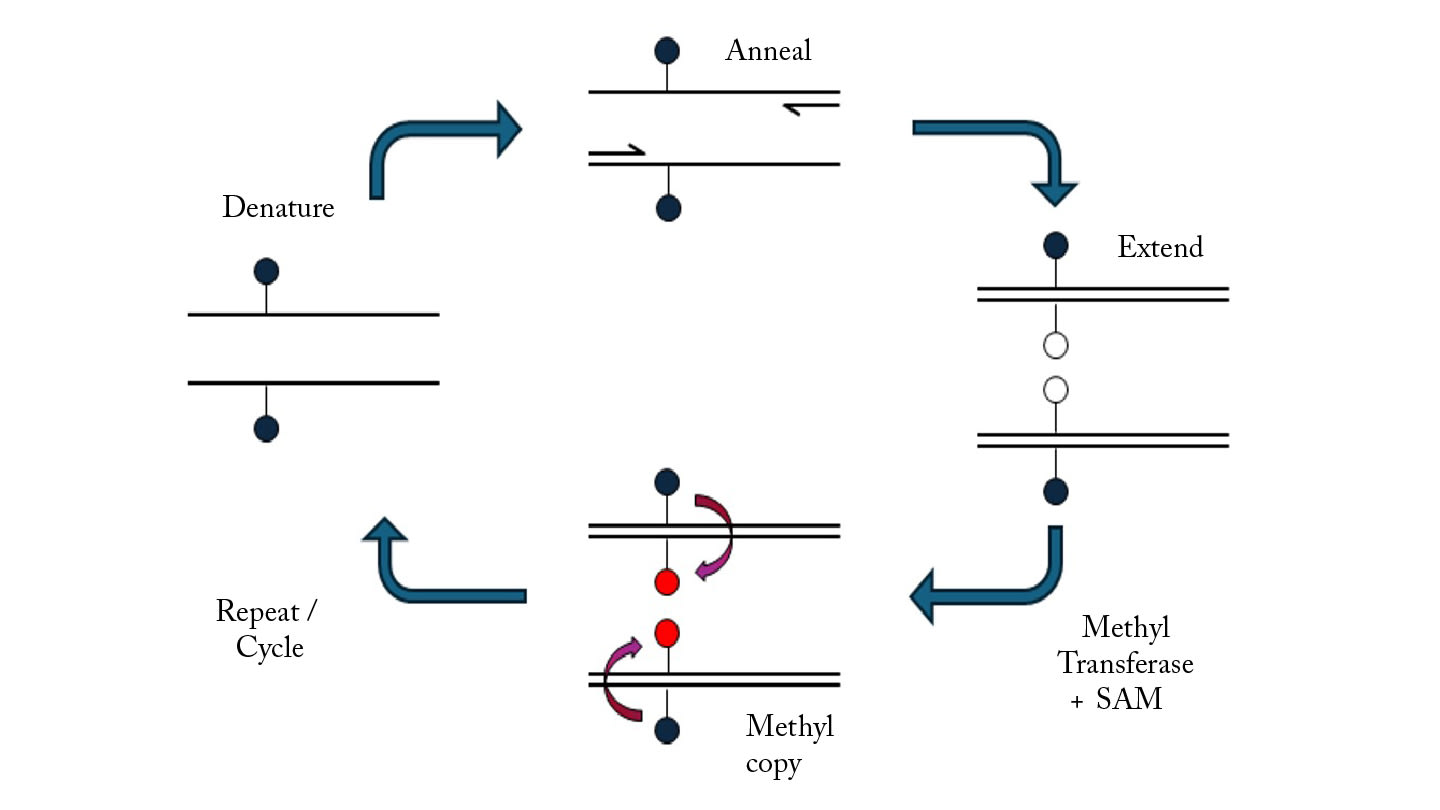
Caption: mcPCR method. Credit: Syndex Bio

What challenges did you encounter in the development of mcPCR?

Technically, the challenge is to integrate enzymatic copying of methylation into a PCR-like cyclic workflow without sacrificing fidelity, yield, or compatibility with downstream sequencing and multi‑omic analyses.

There is also the translational challenge of engineering the platform for high-throughput, non-destructive workflows that work reliably on low-input, non-invasive, and small-sample biopsies, typical of early detection and recurrence monitoring settings.

How might mcPCR capability impact diagnostics?

By enabling amplification of methylation patterns, mcPCR could unlock more sensitive methylation-based assays for cancer, chronic disease, and residual disease monitoring, particularly when only tiny amounts of DNA are available.

This may broaden the use of methylation biomarkers beyond specialized sequencing-only pipelines, supporting earlier and more accurate detection from blood and other minimally invasive samples.

How might it impact patients?

If methylation can be read out more sensitively from non-invasive and small biopsies, clinicians could detect disease earlier, monitor response and recurrence more precisely, and potentially reduce the need for more invasive tissue procedures.

For patients, that could translate into earlier intervention, better tailoring of therapy, and more comfortable longitudinal monitoring over the course of treatment and survivorship.

Newsletters

Receive the latest pathologist news, personalities, education, and career development – weekly to your inbox.

Newsletter Signup Image

About the Author(s)

Helen Bristow

Combining my dual backgrounds in science and communications to bring you compelling content in your speciality.

More Articles by Helen Bristow

Explore More in Pathology

Dive deeper into the world of pathology. Explore the latest articles, case studies, expert insights, and groundbreaking research.

False

Advertisement

Recommended

False

Related Content

Breathing New Life into Diagnostics
Genetics and epigenetics
Breathing New Life into Diagnostics

January 22, 2024

6 min read

Jonathan Edgeworth on how metagenomics could transform testing for respiratory infections

Molecular Spectacular
Genetics and epigenetics
Molecular Spectacular

January 8, 2024

1 min read

A look at last year’s most interesting molecular pathology stories

Redefining Diagnostic Reference Standards
Genetics and epigenetics
Redefining Diagnostic Reference Standards

January 3, 2022

1 min read

Find out what Horizon Discovery’s diagnostic reference standards can do for your workflow

Defining the Next Generation of NGS
Genetics and epigenetics
Defining the Next Generation of NGS

December 31, 2021

1 min read

Overcoming challenges of the typical NGS workflow with the Ion Torrent™ Genexus™ System

False

The Pathologist
Subscribe

About

  • About Us
  • Work at Conexiant Europe
  • Terms and Conditions
  • Privacy Policy
  • Advertise With Us
  • Contact Us

Copyright © 2026 Texere Publishing Limited (trading as Conexiant), with registered number 08113419 whose registered office is at Booths No. 1, Booths Park, Chelford Road, Knutsford, England, WA16 8GS.